Theosophy
The All
Getting Started in Theosophy
(And its all
Free Stuff )
People outside
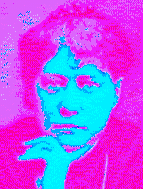
Helena Petrovna Blavatsky
1831 – 1891
____________________
What
Theosophy is
From
A Textbook
of Theosophy By C
“ There is a school of philosophy
still in existence of which modern culture has lost sight.” In these words Mr.
A. P. Sinnett began his 1881 book, The Occult World, the first popular
exposition of Theosophy, published thirty years ago.
During the years that have passed since then, many thousands have
learned wisdom in that school, yet to the majority its teachings are still
unknown, and they can give only the vaguest of replies to the query, “What is
Theosophy?”
Two books already exist which answer that question: Mr. Sinnett’s
Esoteric Buddhism and Mrs. Besant’s The Ancient Wisdom. I have no thought of
entering into competition with those standard works; what I desire is to
present a
statement, as clear and simple as I can make it, which may be regarded
as introductory to them.
We often speak of Theosophy as not in itself a religion, but the truth
which lies behind all religions alike. That is so; yet, from another point of
view, we may surely say that it is at once a philosophy, because it puts
plainly before us an explanation of the scheme of evolution of both the souls
and the bodies contained, in our solar system. It is a religion in so far as,
having shown us the course of ordinary evolution, it also puts before us and
advises a method of shortening that course, so that by conscious effort we may
progress more directly towards the goal. It is a science, because it treats
both these subjects as matters not of theological belief but of direct
knowledge obtainable by study and investigation. It asserts that man has no
need to trust to blind faith, because he has within him latent powers which,
when aroused, enable him to see and examine for himself, and it proceeds to
prove its case by showing how those powers may be awakened. It is itself a
result of the awakening of such powers by men, for the teachings which it puts
before us are founded upon direct observations made in the past, and rendered
possible only by such development.
As a philosophy, it explains to us that the solar system is a carefully
- ordered mechanism, a manifestation of a magnificent life, of which man is but
a small part. Nevertheless, it takes up that small part which immediately
concerns us, and treats it exhaustively under three heads – present, past and
future.
It deals with the present by describing what man really is, as seen by
means of developed faculties. It is customary to speak of man as having a soul.
Theosophy, as the result of direct investigation, reverses that dictum,
and states that man is a soul, and has a body – in fact several bodies, which
are his vehicles and instruments in various worlds. These worlds are not
separate in space; they are simultaneously present with us, here and now, and
can be examined; they are the divisions of the material side of Nature –
different degrees of density in the aggregation of matter, as will presently be
explained in detail.
Man has an existence in several of these, but is normally conscious only
of the lowest, though sometimes in dreams and trances he has glimpses of some
of the others.
What is called death is the laying aside of the vehicle belonging to
this lowest world, but the soul or real man in a higher world is no more
changed or affected by this than the physical man is changed or affected when
he removes his overcoat. All this is a matter, not of speculation, but of
observation and experiment.
Theosophy has much to tell us of the past history of man – of how in the
course of evolution he has come to what he now is. This also is a matter of
observation, because of the fact that there exists an indelible record of all
that has taken place – a sort of memory of Nature – by examining which the
scenes of earlier evolution may be made to pass before the eyes of the
investigator as though they were happening at this moment. By thus studying the
past we learn that man is divine in origin and that he has a long evolution
behind him – a double evolution, that of the life or soul within, and that of
the outer form. We learn, too, that the life of man as a soul is of what to us
seems enormous length, and that what we have been in the habit of calling his
life is in reality only one day of his real existence.
He has already lived through many such days, and has many more of them
yet before him; and if we wish to understand the real life and its object, we
must consider it in relation not only to this one day of it, which begins with
birth and ends with death, but also to the days which have gone before and
those which are yet to come.
Of those that are yet to come there is also much to be said, and on this
subject too a great deal of definite information is available. Such information
is obtainable, first, from men who have already passed much further along the
road of evolution than we, and have consequently direct experience of it; and,
secondly, from inferences drawn from the obvious direction of the steps which
we seem to have been previously taken. The goal of this particular cycle, is in
sight, though still far above us but it would seem that, even when that has
been attained, an infinity of progress still lies before everyone who is
willing to undertake it.
One of the most striking advantages of Theosophy is that the light which
it brings to us at once solves many of our problems, clears away many
difficulties, accounts for the apparent injustices of life, and in all
directions brings order out of seeming chaos. Thus while some of its teaching
is based upon the observation of forces whose direct working is somewhat beyond
the ken of the ordinary man of the world, if the latter will accept it as a
hypothesis he will very soon come to see that it must be a correct one, because
it, and it alone, furnishes a coherent and reasonable explanation of the drama
of life which is being played before him.
The existence of Perfected Men, and the possibility of coming into touch
with Them and being taught by Them, are
prominent among the great new truths which Theosophy brings to the Western
World. Another of them is the stupendous fact that the world is not drifting
blindly into anarchy, but that its progress is under the control of a perfectly
organized Hierarchy, so that final failure even for the tiniest of its units is
of all impossibilities the most impossible. A glimpse of the working of that
Hierarchy inevitably engenders the desire to co-operate with it, to serve under
it, in however humble a capacity, and some time in the far-distant future to be
worthy to join the outer
fringes of its ranks.
This brings us to that aspect of Theosophy which we have called
religious. Those who come to know and to understand these things are
dissatisfied with the slow aeons of evolution; they yearn to become more
immediately useful, and so they demand and obtain knowledge of the shorter but
steeper Path. There is no possibility of escaping the amount of work that has
to be done. It is like carrying a load up a mountain; whether one carries it
straight up a steep path or more gradually by a road of gentle slope, precisely
the same number of foot-pounds must be exerted. Therefore to do the same work
in a small fraction of the time means determined effort. It can be done,
however, for it has been done; and those who have done it agree that it far
more than repays the trouble.
The limitations of the various vehicles are thereby gradually
transcended, and the liberated man becomes an intelligent co-worker in the
mighty plan for the evolution of all beings.
In its capacity as a religion, too, Theosophy gives its followers a rule
of life, based not on alleged commands delivered at some remote period of the
past, but on plain common sense as indicated by observed facts. The attitude of
the student of Theosophy towards the rules which it prescribes resembles rather
that which we adopt to hygienic regulations than obedience to religious
commandments. We may say, if we wish, that this thing or that is in accordance
with the divine Will, for the divine Will is expressed in what we know as the
laws of nature. Because that Will wisely ordereth all things, to infringe its
laws means to disturb the smooth working of the scheme, to hold back for a
moment that fragment or tiny part of evolution, and consequently to bring
discomfort upon ourselves and others. It is for that reason that the wise man
avoids infringing them – not to escape the imaginary wrath of some offended
deity.
But if from a certain point of view we may think of Theosophy as a
religion, we must note two great points of difference between it and what is
ordinarily called religion in the West. First, it neither demands belief from
its followers, nor does it even speak of belief in the sense in which that word
is usually employed. The student of occult science either knows a thing or
suspends his judgment about it; there is no place in his scheme for blind
faith.
Naturally, beginners in the study cannot yet know for themselves, so
they are asked to read the results of the various observations and to deal with
them as probable hypothesis – provisionally to accept and act upon them, until
such time as they can prove for themselves.
Secondly, Theosophy never endeavours to convert any man from whatever
religion he already holds. On the contrary, it explains his religion to him,
and enables him to see in it deeper meanings than he has ever known before. It
teaches him to understand it and live it better than he did, and in many cases
it gives back to him, on a higher and more intelligent level, the faith in it
which he had previously all but lost.
Theosophy has its aspect as a science also; it is in very truth a
science of life, a science of the soul. It applies to everything the scientific
method of oft-repeated, painstaking observation, and then tabulates the results
and makes deductions from them.
In this way it has investigated the various planes of nature, the
conditions of man’s consciousness during life and after what is commonly called
death. It cannot be too often repeated that its statements on all these matters
are not vague guesses or tenets of faith, but are based upon direct and
oft-repeated observation of what happens. Its investigators have dealt also to
a certain extent with subjects more in the range of ordinary science, as may be
seen by those who read the recently issued book on Occult
Chemistry.
Thus we see that Theosophy combines within itself some of the
characteristics of philosophy, religion and science. What, it might be asked,
is its gospel for this weary world? What are the main points which emerge from
its investigations?
What are the great facts which it has to lay before humanity? They have
been well summed up under three main heads.
“There are three truths which are absolute, and which cannot be lost,
but yet may remain silent for lack of speech.
“The soul of man is immortal, and its future is the future of a thing
whose growth and splendour has no limit.
“The principle which gives life dwells in us and without us, is undying
and eternally beneficent, is not heard or seen or smelt, but is perceived by
the man who desires perception
“Each man is his own absolute lawgiver; the dispenser of glory or gloom
to himself; the decreer of his life, his reward, his punishment.
“These truths, which are as great as is life itself, are as simple as
the simplest mind of man”.
Put shortly, and in the language of the man of the street, this means
that God is good, that man is immortal, and that as we sow so we must reap.
There is a definite scheme of things; it is under intelligent direction and
works under immutable laws. Man has his place in this scheme and is living
under these laws.
If he understands them and
co-operates with them, he will advance rapidly and will be happy; if he does
not understand them – if wittingly or unwittingly, he breaks them, he will
delay his progress and be miserable. These are not theories, but proved facts.
Let him who doubts read on, and he will see.
______________________
The All
Guide to
Getting Started in Theosophy
_______________________
Find out
more about
Theosophy
with these links
Theosophy Cardiff’s Instant Guide
Independent Theosophical Blog
One liners and quick explanations
About aspects of Theosophy
H P Blavatsky is usually the only
Theosophist that most people have ever
heard of. Let’s put that right
The Voice of the Silence Website
An Independent Theosophical Republic
Links to Free Online Theosophy
Study Resources; Courses, Writings,
This is actually an introductory handout for study
groups which can you print off and read at your leisure.
No
Aardvarks were harmed in the
The Spiritual Home of Urban Theosophy
The Earth Base for Evolutionary Theosophy
Try these if you are looking for a
Local Theosophy
Group or Centre
UK Listing of Theosophical Groups
Wales
Theosophy Links Summary
All Wales
Guide to Theosophy Instant Guide to Theosophy
Theosophy
Wales Hornet Theosophy Wales Now
Cardiff
Theosophical Archive Elementary Theosophy
Basic
Theosophy Theosophy in Cardiff Theosophy in
Wales
Hey Look!
Theosophy in Cardiff Streetwise
Theosophy
Grand
Tour Theosophy Aardvark Theosophy
Starts Here
Theosophy
206 Biography of William Q Judge
Theosophy Cardiff’s Face Book of Great Theosophists
_____________________________________
The Empath; A Theosophical View
https://www.youtube.com/watch?v=_bPDlYfGT_Y&t=22s
https://www.youtube.com/watch?v=FOi9Jy7cuQQ&t=5s
https://www.youtube.com/watch?v=Cy-quIQxVxI&t=23s
https://www.youtube.com/watch?v=_3zUUZQSYFs
Clearing Emotional Debris from Your Home
https://www.youtube.com/watch?v=b0DsoHI0MMc&t=20s
Will
Life Threatening Global Problems Replace War?
https://www.youtube.com/watch?v=K8oayLKWQi4
https://www.youtube.com/watch?v=qWTioaIUgPQ&t=17s
https://www.youtube.com/watch?v=nGgxoVItpVc&t=30s
Causes of Immediate Reincarnation
https://www.youtube.com/watch?v=8HSUd_w7x4M&t=35s
https://www.youtube.com/watch?v=tJxYtUwRjJk
Trapped in the Wheel of Samsara.
Reincarnation without Spiritual Progress
https://www.youtube.com/watch?v=hNhPHUgpFiQ&t=16s
Reincarnation
& Population Increase
https://www.youtube.com/watch?v=WBfRamMv_F0
https://www.youtube.com/watch?v=W-duEHD86aY
The Benefits of Making a
Stand
https://www.youtube.com/watch?v=j4d7CEX00t0&t=7s
https://www.youtube.com/watch?v=-MrG9xrROyQ&t=25s
https://www.youtube.com/watch?v=V4CHHIs0Ekg&t=34s
A
Theosophical View of Human Imagination
https://www.youtube.com/watch?v=D2aKJ-SRX_4
Addiction to Mental Stimulation
https://www.youtube.com/watch?v=tcHAK3RbIjA&t=7s
Reincarnation
is Pointless without the Role of Karma
https://www.youtube.com/watch?v=NCZ2nHWDcsw
__________________________________